
The Facilitator Advantage
- Afzul Soobedaar
- 07/06/2023
- 12:33
- 0 comments
Most leadership teams are capable of running their own meetings and workshops. They know the subject matter, understand the context, and have the seniority to make decisions.
And yet, when those same teams try to facilitate their own high-stakes sessions, something often goes wrong. The most senior person in the room shapes the discussion too heavily. Quieter voices stay quiet. The group circles the same ground without reaching resolution. The session ends with energy but no clear output.
This is not a failure of intelligence or commitment. It is a structural problem. When the person leading the discussion is also a participant in it, they cannot do both jobs well at once. They are simultaneously trying to think about the content and manage the process, and one of those tasks will suffer.
That is the core argument for using a skilled workshop facilitator. Not as a luxury, but as a practical response to a genuine limitation in how groups work.
What a facilitated workshop actually is
A facilitated workshop is a structured session with a clear deliverable, a defined group of participants with the knowledge and authority to produce that deliverable, a fixed timeframe, and a facilitator who is responsible for the process rather than the outcome.
That last distinction is the critical one. The facilitator's job is not to provide the answer. It is to create the conditions in which the group can reach the answer themselves, by structuring the conversation, managing participation, challenging assumptions, and ensuring the session moves from discussion to decision to action.
This is different from a meeting in both design and intent. A meeting is a format. A facilitated workshop is a process.
Five reasons a workshop facilitator makes a meaningful difference
1. The facilitator holds the process so the group can focus on the problem
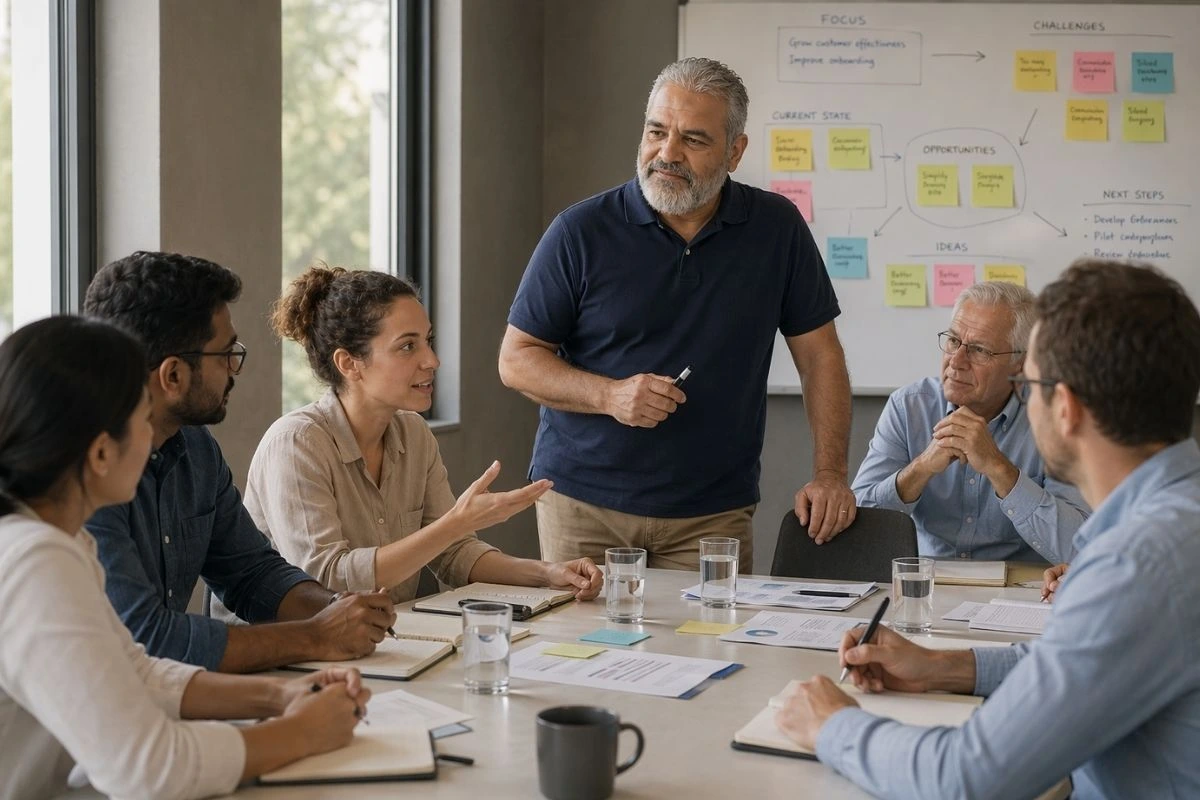
In a facilitated workshop, the facilitator takes full ownership of the process. They design the session, manage the time, sequence the activities, and ensure the group moves deliberately from one stage to the next. That frees every participant, including the most senior leader in the room, to focus entirely on the substance of the discussion.
This separation of roles is more valuable than it sounds. When a leader is trying to facilitate and contribute simultaneously, they tend to either dominate the discussion or hold back too much. Neither produces the best outcome. A skilled workshop facilitator removes that tension entirely.
2. A neutral presence changes what gets said
When someone with authority over the participants is also running the session, people calibrate what they say accordingly. They read the room and pick up on the leader's signals. As a result, they moderate their contributions to stay safe rather than speak freely.
A workshop facilitator has no stake in the outcome and no authority over the participants. That neutrality creates a different kind of conversation. People are more likely to raise difficult questions, surface uncomfortable truths, and challenge assumptions when they know the facilitator's job is to make space for all of it rather than to steer toward a predetermined conclusion.
Some of the most important insights in a workshop come from the contributions that would never have been made without that neutral presence in the room.
3. Conflict becomes productive rather than personal
Every group dealing with a complex or contentious issue will encounter friction. That friction is not a problem. It is often where the most valuable thinking happens. But unmanaged conflict in a meeting tends to become personal, entrenched, or simply avoided.
A skilled workshop facilitator manages conflict without suppressing it. They use structured techniques to separate positions from interests, to reframe disagreements as shared problems, and to ensure that competing perspectives are heard rather than dismissed. The result is a conversation that uses tension productively rather than being derailed by it.
This is particularly valuable in leadership teams where interpersonal dynamics, history, and hierarchy can make honest conversation difficult.
4. Decisions get made and owned
One of the most persistent frustrations in organisational life is the meeting that produces discussion but not decisions, or decisions that are made in the room but not followed through afterwards because participants did not genuinely buy in.
A well-designed facilitated workshop addresses both problems. The process builds toward a decision rather than circling around it. An owner is identified at the outset, the person with the authority and accountability to make or confirm the final call. And because the group has worked through the problem together, the decision that emerges carries genuine collective ownership. People are far more likely to follow through on a commitment they helped shape than one that was handed down to them.
5. The session produces a usable output
Meetings produce notes. Facilitated workshops produce outputs.
The distinction matters. A skilled workshop facilitator designs each session around a specific, tangible deliverable, whether that is a defined strategy, a resolved problem, a clear action plan, or an aligned team. Every activity in the session is designed to move the group toward that output. The session is not finished until the deliverable exists and the group has agreed on it.
This is what separates a facilitated workshop from a well-intentioned but unstructured meeting. The facilitator's job is not just to manage the conversation. It is to ensure that something concrete comes out of it.
What this looks like in practice
At Perispec, facilitation sits at the centre of everything we do. Whether we are running a Strategy Sprint to help a leadership team define their direction, a Decision Sprint to resolve a complex and stuck problem, a Team Alignment Sprint to get a management team working from a common foundation, or a custom workshop designed around a specific challenge, the same facilitation principles apply.
Every session has a clear purpose. Each participant has space to contribute. Every workshop ends with a defined output and a concrete next step.
Not yet sure whether a facilitated workshop is the right format for your challenge? Read Why Facilitated Workshops Outperform Meetings.
If your team is preparing for a high-stakes session, a significant decision, or a conversation that previous meetings have not been able to resolve, it may be worth considering what a skilled workshop facilitator could make possible.
Book a free 30-minute consultation to explore whether this approach could work for your situation.