
Purpose-Led Strategy for Small Businesses
- Afzul Soobedaar
- 10/04/2026
- 12:56
- 0 comments
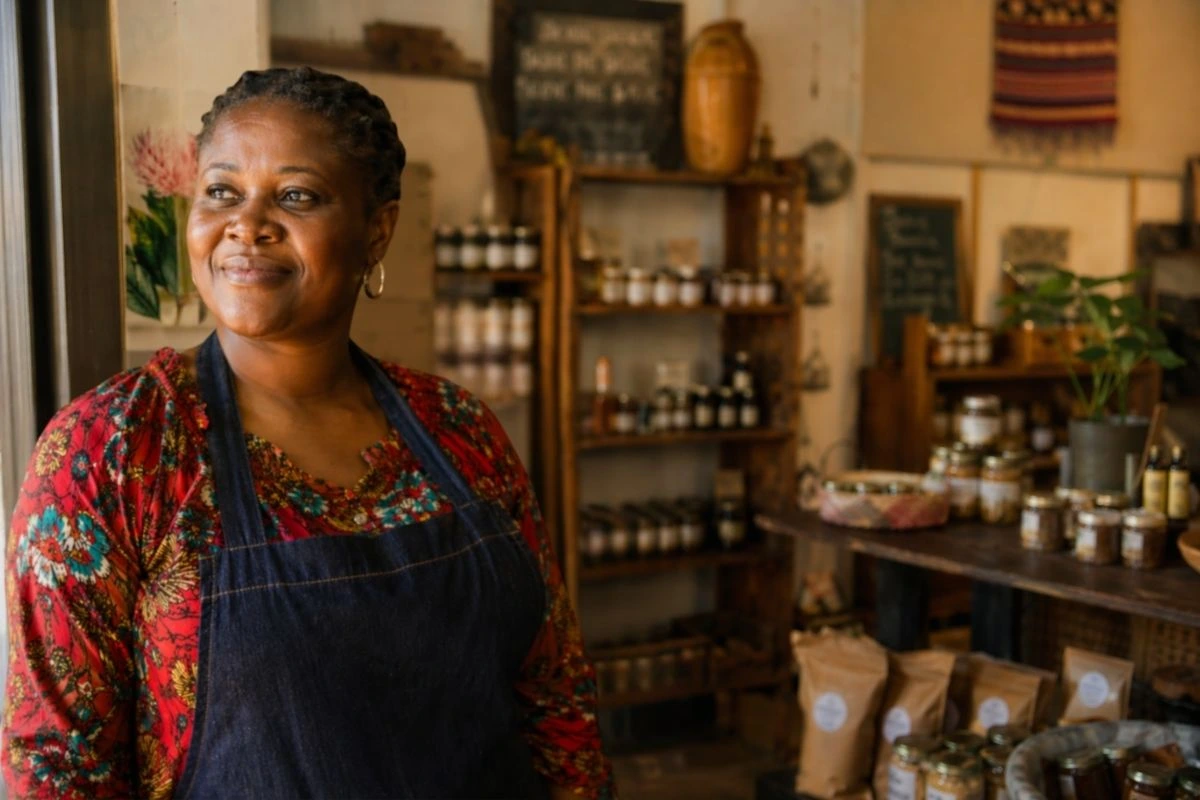
Mpho Mathabi is a qualified occupational therapist from Venda. After years working in a hospital, she resigned and made a decision that would change the direction of her life. She started making organic, preservative-free peanut butter in her garage.
What began as a small production operation using only local, natural ingredients grew quickly. Within months, Peanata was reaching wholesalers across multiple provinces. Mpho also began working with women in her community as resellers and wholesalers, helping them understand pricing and sales.
The shift that made the difference was not just operational. It was purposeful. Once Mpho became clearer about what the business was really about, creating opportunity through quality food and local enterprise, customers stopped seeing Peanata as just another food product. They saw a business with a deeper reason for existing.
Her story shows what purpose-led strategy for small businesses actually looks like in practice. Not as a corporate exercise, but as a shift in how a business understands why it exists and the difference it wants to make.
Why purpose-led strategy matters for small businesses
Before going further, it is worth briefly revisiting what purpose means.
As explained in my earlier article, Purpose-Led Strategy: Why It Matters, the Enacting Purpose Initiative defines purpose as the reason a business exists. It is not just about making money. It is about solving real problems. Professor Colin Mayer, one of the Initiative's founders, argues that the purpose of business is to solve the problems of people and planet profitably, not profit from causing problems.
Many South African small businesses assume this kind of thinking is only for large corporates with strategy departments and large budgets. It is not. In many ways, small businesses are better placed to act on purpose than larger organisations.
They tend to be closer to customers, quicker to respond, and less burdened by hierarchy. That makes it easier to connect purpose to real decisions, real behaviour, and real change.
A purpose-led strategy means your decisions are guided by a clear understanding of the problem your business exists to solve, not just the product or service you happen to sell. It is the difference between saying "we make peanut butter" and saying "we create opportunity through food entrepreneurship."
For small businesses operating in South Africa's tough environment of rising costs, uncertainty, and constant competition, that clarity can become a real source of differentiation.
The small business advantage
Small businesses have natural advantages when it comes to turning purpose into performance. Unlike large organisations, they can align leadership, culture, and customer experience far more easily. Their size often makes it possible to move from intention to action without the drag of internal complexity.
The following advantages show why purpose-led strategy is often easier to activate in a small business than in a large one.
Direct leadership impact: In a small business, when the owner is clear about purpose, that clarity can shape the business immediately. There are no layers of management to dilute the message or delay action. The owner's convictions tend to show up quickly in priorities, decisions, and behaviour.
Authentic relationships: Small businesses are often closer to their customers, suppliers, and communities than larger organisations could ever be. That proximity creates room for a more authentic expression of purpose.Customers frequently know the owner or leadership team personally. That makes purpose easier to believe when it is reflected in actual behaviour.
Speed to action: Small businesses can often act quickly. They can test ideas, adjust course, and make purpose-led changes without waiting for long budget cycles or multiple rounds of stakeholder approval. That agility matters in South Africa, where shifting economic conditions, load-shedding, supply pressures, and changing customer realities often demand quick decisions.
Employee ownership of purpose: In a small business, people usually see more clearly how their work connects to the bigger picture. That can create a stronger sense of accountability, pride, and ownership. With fewer layers and broader roles, staff are often more aware of how their contributions affect customers and advance the business's purpose. When handled well, that strengthens both culture and performance.
How to define your business purpose: a practical framework
Every small business begins with a story. Sometimes it starts with frustration. Sometimes with an insight, a conviction, or a need that nobody else seemed to be addressing properly. Whatever form it takes, that origin often holds the seed of purpose. It tells you not just what the business does, but why it exists in the first place.
The four purpose questions for small businesses
Ask these four questions to help uncover purpose without overcomplicating the process.
- What problems are you seeking to solve? This is the foundation of your purpose. Focus on the real-world challenge your business exists to address, not the product or service you sell. The more precisely you can describe the problem, the more useful your purpose becomes as a decision-making tool. A vague problem produces a vague purpose. A specific one gives your business a clear reason for existing that goes beyond what you sell.
- Whose problems are you solving? Purpose requires you to name a real group of people, not an abstraction. The more clearly you can describe who you serve, the better your business can orient itself around their needs. Specificity here is not a limitation. It is a strength. Knowing exactly who you exist to help shapes your offer, your communication, your hiring, and your strategic choices.
- How do you solve these problems? This question is about your distinctive approach, not just your product or service category. Two businesses can serve the same customers and address the same problem in fundamentally different ways. What makes your approach different? What is it about the way you work, the values you bring, or the relationships you build that creates value beyond the obvious? This is where purpose starts to connect with competitive advantage.
- Why are you suited to solve them? This is where purpose connects to credibility. Your background, experience, capabilities, and values are not incidental to your purpose. They are part of what makes it believable and sustainable. A purpose you cannot actually deliver on is not a purpose. It is a positioning statement. This question forces you to ground your purpose in what you genuinely bring to the work.
Crafting your purpose statement
Once you have worked through those questions, turn the answers into a single sentence. Keep it short. If it takes more than 30 seconds to say, or feels like something nobody in the business would naturally repeat, it probably needs more work.
✅ This works:
"We empower rural South African women through food entrepreneurship, creating quality nutrition products and sustainable livelihoods."
❎ This does not:
"We seek to be a leading provider of organic food solutions that leverage sustainable practices to create stakeholder value while empowering marginalised communities through innovative business models."
The first sounds human. The second sounds manufactured. A good purpose statement should be clear enough that an employee, customer, or supplier could understand it immediately and repeat it without effort.
Three critical mistakes to avoid
Mistake 1: Making it too complex
The moment purpose becomes loaded with jargon, it starts losing its value. Purpose should be simple, clear, and human. People inside the business should be able to explain it in plain language. When they can, it starts becoming a real guide for decisions and behaviour rather than a line buried in a presentation.
A 2022 study of South African small businesses found that while the majority had a formal purpose statement, a significant number of employees either did not know it existed or could not describe it. The statement was there. The strategy was not.
Mistake 2: Trying to serve everyone
Purpose brings focus. It helps you get clearer about who you serve best and what kind of value you want to create. Trying to appeal to everyone usually weakens both strategy and positioning. Purpose should help you make choices, to say yes to the right opportunities and no to the wrong ones. That kind of clarity strengthens decision-making and usually makes the business more distinctive in the market.
Mistake 3: Treating purpose as a once-off exercise
Purpose is not something you finalise in a workshop and then leave behind. Treat it as a management discipline. Over time, it should shape how you allocate resources, choose opportunities, and define success. Planning discussions, performance reviews, and leadership conversations should all reflect it.
Purpose-led strategy for small businesses in action
The following South African entrepreneurs illustrate what can happen when a small business is built around a clear sense of purpose. These stories are drawn from coverage by StartupMag, which has documented their journeys in detail.
Peanata
Purpose: Creating opportunity through quality food and local enterprise.
Mpho Mathabi is a qualified occupational therapist from Venda who founded Peanata peanut butter from her garage, using only organic ingredients with no added oils or preservatives. Rather than positioning the business purely around the product, she built it around a deeper commitment to community empowerment, working with local women as wholesalers and resellers and teaching them pricing and sales. Peanata has since expanded to wholesalers across multiple provinces.
Source: StartupMag
Dr Kweteps Creatives
Purpose: Empowering rural communities while bringing African superfoods to modern wellness markets.
Teboho Kwetempane founded Dr Kweteps Creatives in 2019 after noticing the untapped potential of indigenous herbs and moringa growing in communities around him. Rather than sourcing through conventional supply chains, he built direct relationships with Limpopo farmers, keeping the business tightly connected to its roots and ensuring that value flows back into the communities it comes from. He has also developed a digital micro-distribution platform that enables community members to earn income by distributing his products. That combination of community sourcing, social impact, and product innovation gave the brand a credible and distinctive identity in the wellness market.
Source: StartupMag
Tshepo Jeans
Purpose: Creating denim that reflects the identity and pride of the people who wear it.
Tshepo Mohlala started Tshepo Jeans in 2015 with an R8,000 loan and a clear conviction: he wanted to build a fashion brand rooted in African identity rather than imitation of international labels. That sense of purpose shaped everything from the brand's aesthetic to the way it was positioned in the market. What began as a small venture has since grown into a global label with stores across South Africa, Asia, and Australia, worn by names including Beyoncé and Meghan Markle. The business did not grow by chasing trends. It grew by staying true to a clear sense of what it was for and who it was for.
Source: StartupMag
Citizens Automotive
Purpose: Delivering honest, high-quality vehicle care that businesses can rely on.
Nduduzo Vilakazi founded Citizens Automotive after identifying a gap in the market for transparent, reliable fleet maintenance. Rather than competing on price, he built the business around trust and quality workmanship, offering tailored maintenance plans, detailed service reporting, and a consistent focus on minimising client downtime. That commitment to dependability has become the business's most durable competitive asset.
Source: StartupMag
All four businesses were originally featured by StartupMag. Original coverage is acknowledged with thanks.
Why purpose-led strategy works in South Africa's small business environment
South African small businesses operate under real pressure. Economic volatility, infrastructure failures, load-shedding, rising input costs, intense competition, and the ongoing importance of meaningful B-BBEE alignment all shape the environment in which small businesses have to survive and grow. South Africa's broader small business sector, often referred to as the SME sector, faces these challenges collectively, which is precisely why a clear sense of purpose can matter so much.
Purpose-led strategy helps in several ways.
It differentiates the business beyond price. When customers understand what you stand for and why you exist, they are less likely to evaluate you only as a commodity.
A clear purpose can also help attract better people. Many professionals want more than a salary. They want to feel that their work has meaning. A clear purpose can help a smaller business compete more effectively for talent.
It supports more authentic transformation. Businesses that see inclusion, empowerment, and development as part of their reason for existing are more likely to approach B-BBEE and social impact in a meaningful way, rather than as a compliance box to tick.
Purpose also builds resilience. In difficult conditions, it gives the business a clearer anchor. It helps leaders decide what matters most, where to focus, and what to protect when resources are constrained.
Purpose-led strategy is your competitive advantage
Purpose-led strategy for small businesses is not about a polished slogan, a large consulting budget, or months of abstract planning. It is about clarity, consistency, and action.
For small businesses, size is not necessarily a disadvantage here. In many cases, it is exactly what makes purpose-led strategy easier to activate. Smaller organisations can move faster, communicate more directly, and behave more consistently than larger ones.
The real question is not whether purpose matters. It is whether your business is clear enough about its purpose for that clarity to shape strategy, decisions, and performance.
Ready to build a purpose-led strategy for your business?
At Perispec Consulting, we help SMEs turn purpose into practical strategy. Through focused, collaborative Strategy Sprint workshops, we help businesses get clear on what matters, make better decisions, and build a stronger basis for growth.
Book a free 30-minute consultation to explore how purpose-led strategy can work for your business.